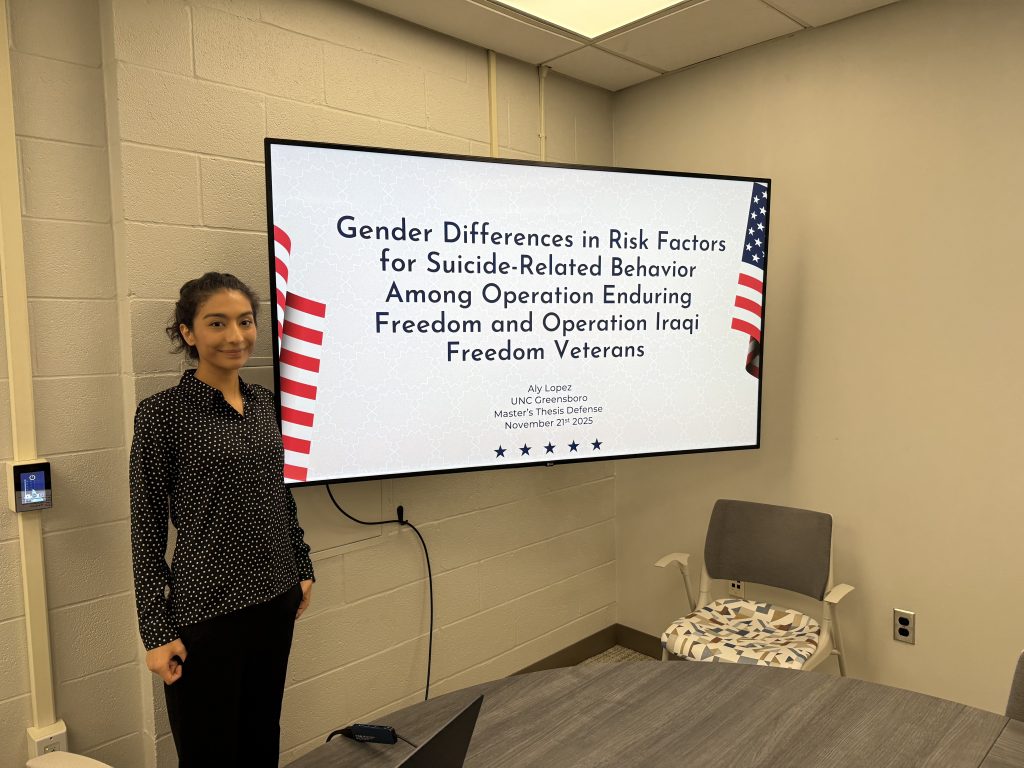
Aly Lopez next to her thesis presentation

Lopez Defends Thesis

Congratulations to clinical psychology student Aly Lopez (faculty mentor: Dr. Blair Wisco), who successfully defended her thesis on Friday, 11/21. Her thesis, entitled “Gender Differences in Risk Factors for Suicide-Related Behavior Among Operation Enduring Freedom/Operation Iraqi Freedom Veterans,” found that similar risk factors for suicide attempts emerged for male and… Continue reading…


a graph that shows increasing productivity

Psychology Publication Update — 11/2/25

UNCG Psychology faculty and students have had a very busy and productive 2025! Check out work from the entire department here. Below, you can find links to publications highlighting recent work from our community. Clinical Psychology Cole, E., Ponder, D., Grillo, A. R., Suresky, R., Stroud, C. B., & Vrshek-Schallhorn,… Continue reading…

Weber Honored for Innovative Research on Veterans

Dr. Danielle Weber, who directs the SHARE Lab, has written an article selected for the 2025 Thompson List. This list recognizes the most important and innovative research studies on military and veteran families published within the last year. The Thompson List aims to elevate research and serves as a resources… Continue reading…

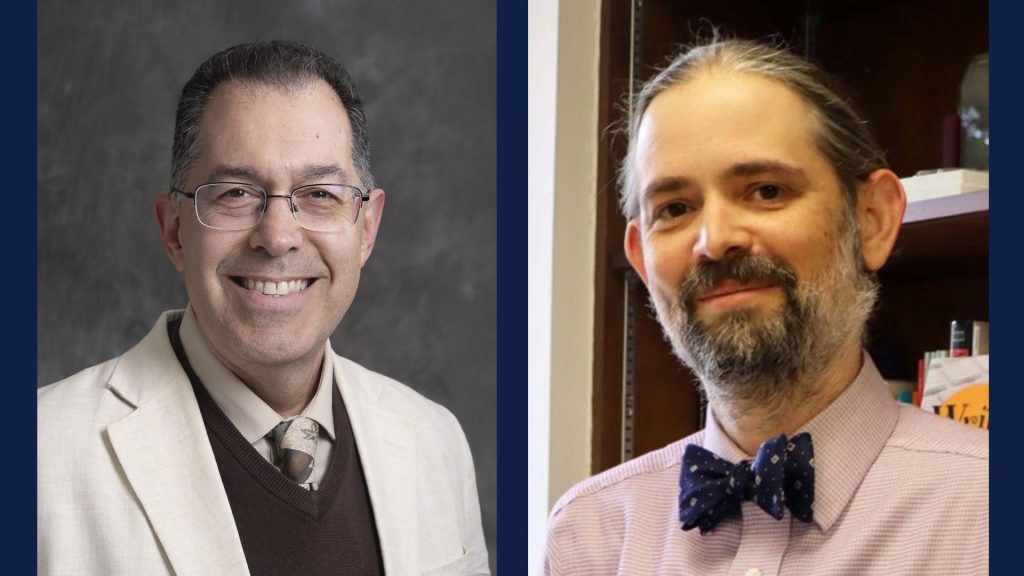
Professor Michael Kane and Professor Paul Silvia

Kane and Silvia receive new IES grant to study academic procrastination

Dr. Michael Kane and Dr. Paul Silvia, both Professors in the Department of Psychology, are UNCG Co-PIs on a new collaborative project funded by the U.S. Department of Education’s Institute of Education Sciences. The project, A Multipronged Approach to Small-Teaching Interventions for Reducing Academic Procrastination: A Randomized Control Study via Terracotta, is led by researchers at the University of Colorado Boulder.

A student procrastinating.

Kane Receives Multi-Site Grant to Study Academic Procrastination

Congratulations to Dr. Mike Kane, who directs the I.D.E.A. Lab, and his collaborators on receiving one million dollars from the Institute of Education Sciences for a multi-site grant to conduct a classroom intervention study focusing on academic procrastination. Academic procrastination is prevalent and associated with worse academic performance and higher… Continue reading…

components of research

Wisco Awarded Funding for Undergraduate Research Experiences

Dr. Blair Wisco, who directs the CoPE Lab, has recently been awarded funding to create meaningful undergraduate research experiences. This funding is part of the College of Arts & Sciences Dean’s Undergraduate Scholars: Advancing Knowledge through Research and Creative Collaboration Program. Dr. Wisco is one of ten College of Arts… Continue reading…

DeJesus Receives Grant Continuation Award

Dr. Jasmine DeJesus, working with with Dr. Jigna Dharod (Nutrition, Health and Human Sciences), received a continuation award from the National Institutes of Health for the project “Breastfeeding intervention to prevent obesity among children.” Learn more from the abstract on NIH RePORTER. Dr. DeJesus directs the UNCG Development, Culture, and… Continue reading…

Wisco and Nester Receive Research Grant

Dr. Blair Wisco and graduate student Shae Nester received a new award from the American Psychological Foundation for the project “A laboratory and ambulatory investigation of trauma-related dissociation, interoceptive accuracy, and interoceptive attention.” Learn more about their work at the CoPE Lab site. Congratulations!

COPE Lab logo

Two new publications from the CoPE lab

The CoPE Lab, led by Dr. Blair Wisco, has been on a productivity tear!  In a lab-wide effort, Dr. Wisco along with grad students Shae Nester, Cameron Pugach, Emily Heinlein, and Alejandra Lopez, published “Do Physiological Measures of Arousal Align with Self-Reported Physical Sensations? Using a Novel Ambulatory Method to… Continue reading…

Strong Minds-Strong Communities logo

New publication from the Strong Minds-Strong Communities program 

New research from UNCG researchers, including Dr. Kari Eddington, and others suggests that using culturally adapted interventions can improve depression and anxiety symptoms. Recently published in The Lancet, this work adds to growing evidence that interventions that address people’s cultures and languages and that are delivered by community health workers… Continue reading…