Who are the people behind the lectern? Did they appear one day to discuss t-tests and theories, and then disappear into the ether? It turns out that faculty are people too! The Department of Psychology strives to create a culture replete with high quality research and teaching. To foster that culture, the “meet the faculty” series is designed to give students an idea of what leads one to pursue a career aligned with this culture.
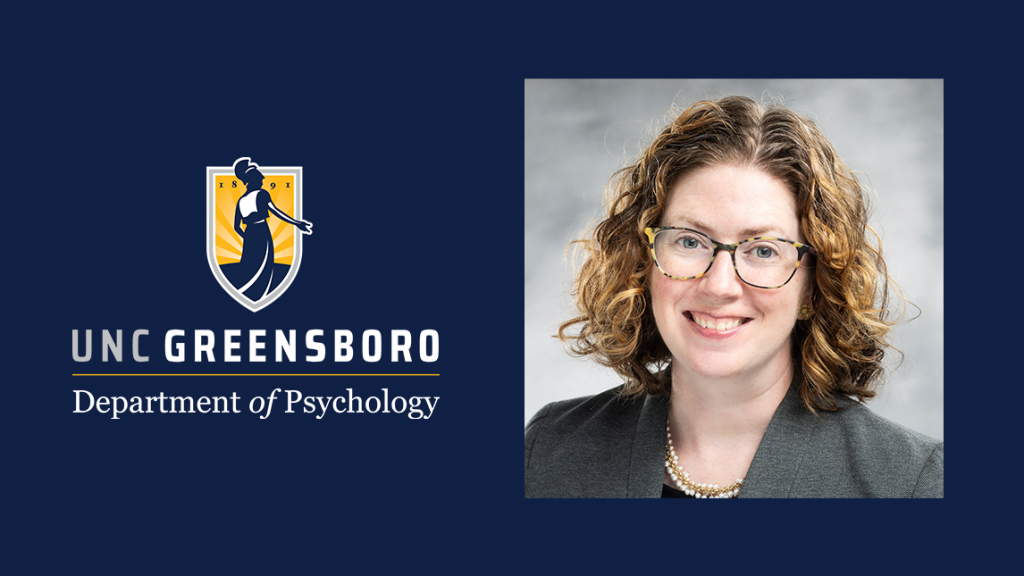
Let’s meet one of our social area faculty, Dr. Brittany Cassidy. Dr. Cassidy grew up in East Wakefield, New Hampshire, and joined the Department of Psychology in Fall 2018. She completed an undergraduate degree at Boston University and earned a Ph.D. from Brandeis University. You can visit Dr. Cassidy’s lab website for more information about her research: www.uncgsocialcognition.com.
Research Background and Interests
What inspired you to become a psychology professor?
I chose psychology as my major in my first semester of college because I thought it seemed cool. It never really hit me that there were people behind the graphs in my textbooks doing the work to make the graphs. I really enjoyed my statistics courses and eventually began volunteering in cognitive neuroscience research studies. I asked a lot of questions and ended up being invited to join a vision science lab where I developed my senior thesis. I was bitten by the research bug—I love asking questions and figuring out ways to address them. I also enjoy being part of a team and “nerding out,” which makes working with students and leading a lab something I really enjoy.
Can you describe your research area and interests?
I am a social psychologist who is interested in person perception, or how people perceive, evaluate, and remember others. I mostly study person perception from the lens of face perception. Even though people often say that they “don’t judge books by their covers,” faces convey a lot of cues by which people form impressions. Showing how profound an impact my undergraduate research experience had on me, one of my research lines involves characterizing how perceptual operations contribute to how people come to understand others. I am also interested in understanding how facial cues like social categories yield biased perceptions of others in ways that contribute to social inequities.
Are there any publications or work of which you’re particularly proud?
I had an interdisciplinary upbringing as a psychologist. Even though my current directions are specific to social psychology, I am proud of research that reflects the spirit of that upbringing. One publication speaking to this upbringing examines how aspects of face processing typically examined in cognitive psychology research contribute to a tendency for people to dehumanize Black relative to White individuals. In this paper (https://doi.org/10.1016/j.jesp.2017.06.018), I showed that reducing configural processing, a well-studied aspect of typical face encoding, decreases the activation of human-related concepts to Black more than White faces. This effect may be, in part, be due to group stereotypes becoming more salient when configural processing is reduced. This paper suggests a role for perceptual processes in an outcome that people might assume to be driven by attitudes and beliefs.
Working and Teaching at UNCG
What drew you to joining the Psychology Department at UNCG?
People who have heard me teach know that I enjoy the phrase “we exist in a context.” In some contexts, people thrive. In others, they struggle. I felt that UNCG had a lot of similarities to where I attended graduate school, a context from which I benefited. I was excited at the prospect of having a small lab where I could work closely with undergraduate and graduate students. I was also excited to be in a department that values collaborative and interdisciplinary work.
Do you have a favorite course that you teach?
I have enjoyed teaching the Psychology of Gender. The topics we discuss are in the news and relevant to everyday life. Because students tend to engage with the material, it gives me a great opportunity to showcase psychology as the science that it is. Everyone has beliefs about gender. In this course, we learn about what evidence there is to support these beliefs. And as someone who loves a graph walk through, I get to explain a lot of graphs and try to get students to enjoy or at least appreciate them.
What advice would you give to students aspiring to a career in your area?
The best thing I did as an undergraduate was joining a lab. I learned that the doing of psychology is very different than the reading about psychology. I became aware that having a healthy appreciation for research methods and statistics is essential to becoming a psychology professor. I am lucky that I like math and was on my way to completing a statistics minor before deciding that I wanted to pursue graduate school. Beyond joining a lab and appreciating statistics, I encourage students to take a wide variety of classes (even outside of psychology) to really explore their interests. I am really into the person perception of women—and part of that is because of a history class I took my sophomore year in college in which I read classic novels about women.
Fun Facts!
What do you like to do outside of work?
I can often be found running, petting my dog, enjoying my houseplants, and surveying North Carolina’s pizza offerings.
What’s something most people don’t know about you?
I am very into the Academy Awards. I like to see as many Best Picture nominees as I can and then see if my “informed” decisions play out with the critics and on Oscar night.
Could you share a favorite movie, book, or band that you would recommend to others?
My comfort movies are Contact and The Social Network. I am a huge Radiohead fan and will take advantage of any opportunity to see them (or their side projects) live. It might take me awhile to get through a novel, but I recently finished The Idiot by Elif Batuman and highly recommend it!