PSY CLINIC Services

PsychologiCAL Services

The UNCG Psychology Clinic offers individual and group therapy services to children and teens, adults, and families. 
Our staff is here to answer your questions and make the process as smooth as possible.

If we are unable to answer your call, please leave a voicemail, and we will return your call as soon as possible.

We understand you may experience a variety of emotions in seeking services for yourself or a loved one and may have many questions. Here is some information about some commonly seen presenting concerns in our clinic and how our clinicians treat them.

Steps to Begin Services

If you are interested in receiving services, please call us at 336.334.5662 or submit a Client Interest Form online.

If you’ve submitted a Client Interest Form on our website, our clinic staff will contact you by phone within 2-3 business days to review our clinic services and policies.

We connect with all potential clients via phone to exchange basic information about the clinic and the person requesting services before we send electronic paperwork so we can ensure we offer the service that’s being requested and that you understand the nature of our training clinic before we ask you to complete any forms.  

We will send you intake paperwork using an encrypted email (from a service called Hushmail). You will be prompted to login or create a password to access the easy-to-complete forms, ensuring your information remains protected. To avoid delays, we strongly recommend completing and returning the paperwork as soon as possible. Please feel free to reach out with any questions along the way.

Once we receive your completed paperwork, our team will review and upload it into our system, which may take up to one week. After processing, your information will be shared with a screening clinician, who will contact you within 2-3 business days.

The screening clinician will reach out to send you a brief questionnaire to complete and schedule a virtual screening appointment (usually 30 minutes – 1 hour), where they will review your presenting concerns, assess whether our clinic is a good fit for your needs, and answer any remaining questions.

If our clinic is determined to be the right fit, you will be placed on our waitlist for the next available clinician. We strive to serve clients as quickly as possible. Once a clinician and their supervisor have been assigned to your treatment team, a clinician will contact you to schedule your first appointment for services!

If we determine from the screening appointment that we are unable to meet your request for services, and/or that you may be better served by another agency, we will provide you with appropriate referral options.

The UNCG Psychology Clinic provides evidence-based treatments to children, adolescents, adults, and families.

Therapy services occur on a weekly (or bi-weekly, as appropriate) basis and typically last 50-55 minutes. Broadly, the aim of therapy is to address and reduce mental health concerns by identifying the presenting concerns and the factors contributing to them, increasing knowledge about the problem (e.g., scientific information about the concern, human development, or how the brain and body function) and increasing skills to more adaptively cope with the presenting problems. 

Therapy services offered at our clinic are designed to be short-term (generally 12-16 sessions). That’s because we use evidence-based interventions and principles, meaning that the treatment is based on science and has been shown to be effective with other individuals experiencing that concern.  

Therapy sessions generally involve the client meeting individually with a therapist. When a child or teenager is the identified client, caregivers and family members will be included in treatment as appropriate (e.g., based on the age of the child). 

If you are interested in starting therapy services, click here to submit a client interest form.

As explained above, therapy services are generally provided on a weekly basis (50-55 minute sessions) and are short-term (12-16 sessions), as they are designed to help clients better understand their concerns and learn skills to address or manage them.

Assessment services are designed to assess whether a variety of symptoms may be explained by psychological disorder(s) or diagnoses. The aim of an assessment is to answer a specific question, for example, “Does my child who is highly distractible and energetic meet criteria for ADHD?” or “I have struggled all my life in school, despite my best efforts. Do I have a learning disability, ADHD, or something else?”

Sometimes, evaluations are also done to apply for testing or other accommodations, disability. We also offer specialized testing to determine whether a child meets the criteria to apply for early kindergarten or is academically gifted. 

Evaluations are typically completed across a few appointments for a few hours each time and include participating in a background interview and standardized psychological and/or cognitive testing, and sometimes obtaining information from people close to the client (e.g., parent/caregiver, teacher). Results of the evaluation will include a summary of test scores and clinical data, a diagnostic summary, and recommendations – all of which will be shared with the client in a feedback session and provided in a written report.

Read more about our assessment services here.

If you are interested in starting either (or both) of these services, click here to submit a client interest form.

Teletherapy, also known as telehealth or virtual therapy is a video conferencing option for conducting therapy sessions remotely over the internet. Virtual services are not appropriate for all clients or situations. We can offer teletherapy for clients who have barriers to conducting in-person therapy sessions, if the client, their concerns, and selected intervention are appropriate to be delivered virtually. Please inform our staff and your screening clinician if you are interested in being considered for teletherapy options. Please note that requests for teletherapy must be approved by the clinician’s supervisor.  

Cognitive Behavioral Therapy (CBT) focuses on changing negative thought patterns and behaviors to improve emotional regulation and develop personal coping strategies.  

Acceptance and Commitment Therapy (ACT) encourages individuals to embrace their thoughts and feelings rather than fighting them. ACT utilizes mindfulness and coping strategies to help individuals live and behave in ways consistent with personal values, even in the face of painful experiences. 

Dialectical Behavior Therapy (DBT) is designed to help people who experience intense emotions and provide them with skills to manage these emotions, improve relationships, and live more mindfully. DBT teaches coping strategies for stress, emotional regulation, interpersonal effectiveness, and the balance between acceptance and change. 

Interpersonal Psychotherapy (IPT) examines how conflicts, losses, or changes in relationships contribute to mental health challenges, like depression. IPT focuses on helping individuals improve their relationships and their communication skills to alleviate mental health symptoms.  

Cognitive Processing Therapy helps individuals to process and make sense of traumatic experiences by challenging and modifying unhelpful beliefs related to the trauma event. 

Trauma-Focused Cognitive Behavioral Therapy (TF-CBT) addresses the needs of children and adolescents with post-traumatic stress disorder (PTSD) and other difficulties related to traumatic life events. TF-CBT integrates trauma-sensitive interventions with cognitive behavioral techniques. 

Exposure and Response Prevention Therapy (ERP) is a type of cognitive-behavioral therapy that specifically targets symptoms of obsessive-compulsive disorder (OCD) by exposing individuals to situations related to their obsessions and teaching them to refrain from performing compulsive behaviors. 

Exposure therapies involve gradually and systematically engaging individuals in being exposed to and approaching the objects or situations they fear in a safe and controlled way to help them overcome their fear. 

Parent management training is designed to teach parents techniques for managing their children’s behavior. It focuses on positive reinforcement and consistent discipline to improve parent-child interactions.

Emotion regulation skills are techniques used to manage and respond to emotional experiences in an adaptive way and aim to increase the individual’s control over their emotional responses. 

Social skills training teaches individuals the skills needed for daily social interactions, including communication, problem-solving, and assertiveness. It is often used to help those with social anxiety or neurodevelopmental disorders such as autism spectrum disorder

Interpersonal effectiveness skills, often used in DBT, aim to improve one’s ability to communicate and interact with others assertively, maintain self-respect, and enhance relationships. 

Time management and organizational skills involve strategies for enhancing an individual’s ability to manage time effectively and organize tasks. These skills can include learning how to prioritize tasks, use calendars to schedule tasks, avoid procrastination, and maintain an organized workspace. 

Behavioral strategies aim to change behavior patterns by focusing on reinforcing desirable behaviors and reducing unwanted ones. 

Mindfulness techniques involve practices that cultivate a state of non-judgmental awareness of the present moment. Mindfulness skills are foundational for enhanced emotional regulation.  

Relaxation techniques include deep breathing, progressive muscle relaxation, and guided imagery, which aim to reduce stress and promote physical and mental relaxation. 

The UNCG Psychology Clinic provides comprehensive psychological testing/evaluations for a variety of cognitive, educational, emotional, and behavioral difficulties in children, adolescents, and adults. We provide psychological assessments to evaluate a wide range of mental health and academic concerns, as well as “academically gifted” and “early Kindergarten” evaluations.

Psychological evaluations are tailored to address the referral question and current difficulties clients have when seeking services. Individuals may seek an evaluation for themselves or their child/adolescent to gain a deeper understanding of the impact emotional, behavioral, and/or interpersonal factors have on functioning and may result in psychological diagnosis/diagnoses. 

This type of evaluation may benefit clients by gaining a better understanding of their mental health condition and it can also determine whether he/she/they require therapeutic services and/or academic accommodations. 

Common areas of concern explored through assessments include symptoms of:   

Please note: We do not offer psychological evaluations for Autism Spectrum Disorder

For students within a public school system, tests assessing cognitive abilities and academic achievement may be considered for eligibility for academically gifted (AG) services. These evaluations are not comprehensive and measures may vary based on county. Guilford County Schools (GCS), for example, will only accept a score indicating cognitive ability and achievement scores related only to reading and math abilities.  

Please be sure to indicate your child’s school county when requesting these services. 

Please note Medicaid will not cover the cost of Early Kindergarten evaluations. Medicaid clients seeking these assessments will be expected to self-pay. Sliding scale rates are available. 

Please note that the requirements set by school districts to qualify for Academically Gifted services is very stringent and many academically advanced youth do not meet criteria. Please visit the Guildford County Schools website or corresponding website for your child’s county to learn more. Nonetheless, the results of this test can provide you with insights on how to best support your child’s unique academic strengths and how to bolster your child’s areas of growth. 

For caregivers who believe their young children are especially gifted, it is possible that they may be eligible for early entrance into Kindergarten. Early-K evaluations generally involve cognitive and achievement testing. 

Children must be 4 years old on or before April 16th of the year they hope to enter Kindergarten. Early Kindergarten evaluations may be conducted after April 16 each year and documentation must be completed and submitted to the appropriate school district prior to the first day of the academic school year. 

For parents interested in this service, please note that there are other requirements necessary including a “portfolio” of their child’s work and letters of recommendation.

Please be sure to indicate your child’s school county when requesting these services as the forms and process may vary by county, though they will all comply with the requirements set by the NC State Board of Education.

Please note Medicaid will not cover the cost of Early Kindergarten evaluations. Medicaid clients seeking these assessments will be expected to self-pay. Sliding scale rates are available. 

Psychological assessments, or evaluations, often involve multiple testing appointments of a few hours each. This allows for review of clinic policies and procedures, obtaining relevant background information, completing self-report measures (sometimes requested to be completed between sessions, and sometimes from other informants like parents or teachers, if relevant) and conducting standardized psychological testing.

As a result of our comprehensive assessments, clients will be provided with a feedback session to explain the findings from the evaluation, as well as a detailed written report that includes a summary of assessment procedures, significant findings and results, and recommendations for improvement and success. 

UNCG students may request their results to be shared with the Office of Accessibility Resources & Services (OARS) to facilitate appropriate accommodations. As always, results will never be shared with anyone without the client, or authorized representative’s written permission. Students may be asked to sign an authorization at their screening appointment so clinic staff may communicate with OARS to let them know you are on our waiting list, as they may be able to offer provisional accommodations while students await their evaluation appointment. 

As of January 2025, we are not accepting requests for evaluations of autism spectrum disorder (ASD). We believe you would be better served by one of the autism specialty clinics in our area. If you are seeking an evaluation for other concerns (e.g., ADHD, learning disability) and you suspect symptoms of autism, we may include some brief screening measures in our assessment that would help us determine if we recommend you seek an autism-specific evaluation at another clinic, or if it is unlikely you (or your child) would qualify for an autism diagnosis. 

Our assessments include an intake session, multiple testing sessions, a feedback session, and a detailed written report. Each assessment is individualized to meet your specific needs, so the process may vary from person to person. On average, you will meet with your clinician 2–6 times, with each session lasting approximately 2 hours. All sessions are covered under a flat testing package rate.

Once your assessment is complete, you will return for a final feedback session, during which your clinician will review the report with you, discuss assessment outcomes, provide future recommendations, and give you a copy of your report.

We can share your assessment results with other providers or schools with your permission. Your clinician can provide you with a release and disclosure form to specify the parties who should receive the report.

We will not share any results without the client or authorized representative’s written permission.

Group therapy brings together multiple people with a common area of difficulty to provide support and introduce new skills. The UNCG Psychology Clinic offers a variety of groups to meet the needs of the community.

Most groups are time-limited (e.g., between 10 to 16 weeks) and meet for 1.5 to 2 hours on a weekly or bi-weekly basis.  

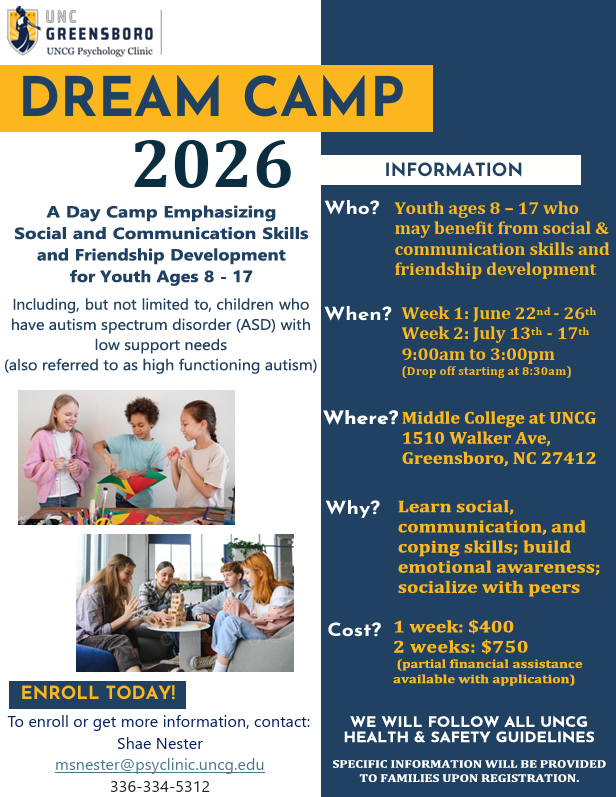
DREAM Camp is a summer day camp designed for children and adolescents (ages 8 to 17) with social skills and friendship challenges, including but not limited to those diagnosed with autism spectrum disorder.

Participants who require substantial individual attention may not be appropriate for this day camp. 

The focus of the camp is to enhance social and friendship skills. In addition, adolescents will receive developmentally appropriate life skills training.  Campers will also participate in enjoyable activities, including arts and crafts, musical performances, and sports! 

Dates Week 1: June 22 – 26
Week 2: July 13 – 17
9 a.m. – 3 p.m.
Location1510 Walker Avenue,
Greensboro, NC 27412
(Middle College at UNCG)
Drop off instruct-ions8:45 a.m. – Park in lot at 1545 Walker Ave and walk child across the street to the Middle College at UNCG (~2 minute walk)
SkillsSocial and communication skills training, emotion understanding and coping, independent living skills
Cost$400 per week (partial financial assistance available)
*Reduced rate if camper attends both sessions
Share This